 RUBBER climbed to a record as the Shanghai market surged after the Lunar New Year break, raising speculation demand for the commodity used in tires from the world’s largest consumer will keep expanding.
The July-delivery contract gained as much as 1.7 per cent to 507.5 yen a kilogram ($6,162 a metric ton) before trading at 503.2 yen on the Tokyo Commodity Exchange at 11:15 a.m. Futures in Shanghai surged 4.3 per cent to an all-time high.
China increased interest rates for the third time in four months yesterday to curb inflation. The People’s Bank of China raised the one-year lending rate by a quarter point to 6.06 per cent and the one-year deposit rate an equivalent amount to 3 per cent.
Premier Wen Jiabao’s government has yet to return rates to pre-crisis levels, seeking to sustain the economy’s rebound to growth of about 10 per cent.
“The moderate increases in Chinese rates are unlikely to derail the nation’s economy from expansion,” Kazuhiko Saito, an analyst at broker Fujitomi Co. in Tokyo, said today by phone. “Rubber extended gains amid speculation demand from China will continue to grow.”
The Chinese central bank moved on the last day of the week-long holiday and before a report next week that may show consumer prices rose 5.3 per cent in January, according to the median estimate in a Bloomberg News survey of economists.
Government figures expected next week are also forecast to show China’s export growth accelerated in January and producer prices advanced at a faster pace, according to Bloomberg surveys.
Rubber futures have gained 22 per cent this year, extending last year’s 50 per cent rally, as rising car sales led by China and India boosted demand for tires.
Output from Thailand, Indonesia and Malaysia, which account for about 70 per cent of global rubber supply, were curbed as a La Nina has led to higher-than-average rains in parts of Southeast Asia. The weather event started in June and usually lasts for nine months or more.
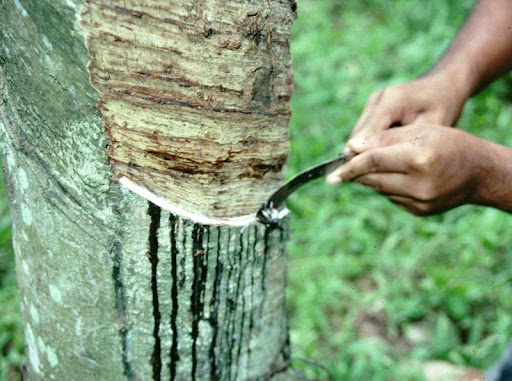
Supply is expected to decline in coming months as the low- production period will start in major growing areas in Thailand, Saito at Fujitomi said. Farmers reduce tapping during the so- called wintering period from February to May, when trees shed leaves and latex production drops. Thai rubber output declines as much as 60 per cent during wintering compared with peak levels, according to the Association of Natural Rubber Producing Countries.
The physical price of natural rubber in Thailand, the world’s largest exporter, extended gains to an all-time high of 187.80 baht ($6.12) per kilogram, boosted by strong demand from local and overseas buyers amid concerns over supply shortages, Rubber Research Institute of Thailand said today.
In Shanghai, May-delivery rubber climbed to a record 43,500 yuan ($6,608) a ton before trading at 42,540 yuan at the 11:30 - a.m. local time break.
Natural-rubber consumption in China may rise 9 per cent to 3.6 million tons this year, while rubber use in India may gain 5.2 percent to 991,000 tons, according to the Association of Natural Rubber Producing Countries. – Bloomberg
(Source: http://www.btimes.com.my/Current_News/BTIMES/articles/20110209124136/Article/index_html)

No comments:
Post a Comment