 Rubber production in Thailand, the world’s largest grower and exporter, may decline as much as 8.3 percent this year from an earlier forecast if rain persists in the country’s south, according to the Thai Rubber Association.
Output may be 3.2 million metric tons this year, down from an earlier estimate of 3.49 million tons, said Luckchai Kittipol, president of the group. Production last year totaled 3.25 million tons, according to the group.
Unseasonal rains from the start of the year caused by a La Nina weather pattern boosted Thailand’s sugar output to record levels, while inundating rubber plantations in the south. Rains may have cut rubber output by 30,000 tons in the second quarter, Luckchai said. Futures of the commodity used in tires and gloves have climbed 30 percent in the past year.
“Floods in southern Thailand have been hurting rubber production,” Luckchai said in a phone interview. The loss forecast was 50 percent higher than an initial estimate on March
30. “We have to continue monitoring the weather to see how bad it will affect rubber output this year,” he said.
Thai production may total 3.43 million tons this year from 3.25 million tons last year, the Kuala Lumpur-based Association of Natural Rubber Producing Countries said in a March report.
Rain inundated 10 southern provinces from March 23 to April 19, and may damage about 50,000 rai (19,641 acres) of rubber plantations, according to the Department of Disaster Prevention & Mitigation. Fourteen provinces in Thai south account for 80 percent of the country’s output, according to the Office of Agricultural Economics.
“Supply will remain tight probably until June when wintering season ends,” Luckchai said. Output during the low-production period falls to as low as 20 percent, he said.
Flooding in Thailand late last year was the worst in five decades, covering two-thirds of the country and damaging 11.1 million rai of agricultural land, equivalent to 8.4 percent of the total, the Office of Agricultural Economics said Dec. 24.
(Bloomberg, Bangkok, April 21, 2011)
Thursday, April 21, 2011
Thai Rubber Output may Miss Target by 8.3% if Rain Persists

Rubber Declines as Toyota Extends Production Cuts After Quake
 Rubber declined on concern that demand may weaken after Toyota Motor Corp., the world’s largest automaker, extended production cuts in some regions because of a parts shortage triggered by Japan’s record quake last month.
The September-delivery contract dropped as much as 3.4 percent to 411.3 yen per kilogram ($5,001 a metric ton) and ended at 412.3 yen on the Tokyo Commodity Exchange. Rubber surged yesterday on concern that supply from Thailand, the largest producer, may be disrupted by floods and rain, and an industry group has forecast that output this year may decline.
Toyota’s North American unit said yesterday that plants will remain shut on Mondays and Fridays and run at 50 percent on the three other weekdays until June 3. Toyota will also shut U.S. plants for a week from May 30 and in Canada from May 23.
“Toyota’s plan to cut production raised concerns that the car market this year may shrink,” Pornthip Wongjirattikarn, marketing manager at Future Agri Trade Co., said by phone from Bangkok. “This would slow demand for rubber.”
In China, the utilization rate at Toyota’s factories will generally be 50 percent of normal and may fall as low as 30 percent from April 21 to June 3, it said in a statement. Japan was rocked by its biggest recorded quake on March 11, triggering power cuts that shuttered factories.
A strengthening Japanese currency also hurt the rubber market, Ker Chung Yang, an analyst at Phillip Futures Pte, said from Singapore. Still, the low-production season, when output falls in top growers, helped to stem declines, he said.
The yen gained to 82.17 per dollar from 82.56 yesterday before a report forecast to show U.S. house prices fell for a fourth month, underscoring prospects the Federal Reserve will maintain monetary stimulus. A stronger Japanese currency boosts the costs of yen-based contracts for holders of other currencies.
China Imports
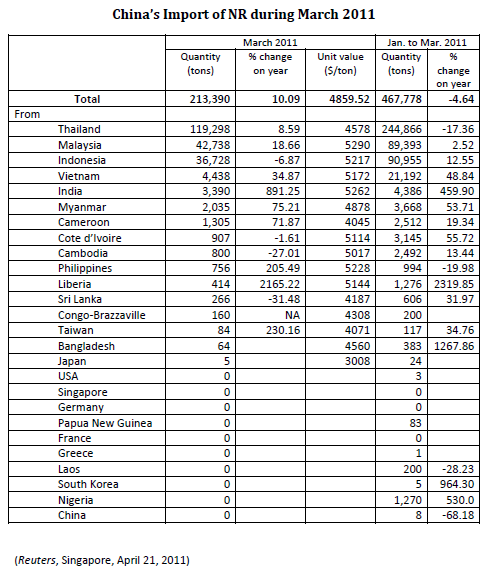
Rubber imports by China declined 4.6 percent to 470,000 tons in the first quarter compared with the year-earlier period, Beijing-based China Customs General Administration said today.
Rubber for September delivery in Shanghai fell 1.1 percent to close at 34,510 yuan ($5,294) a ton after rising as much as 1.1 percent earlier.
The physical price of Thai rubber was unchanged at 177.05 baht ($5.90) per kilogram, according to the Rubber Research Institute of Thailand. Chinese buyers continue to delay purchases, waiting for prices to drop, it said.
Thai rubber output may decline from last year if rains that caused floods persist, according to the Thai Rubber Association. Production may be 3.2 million tons this year, said Luckchai Kittipol, president of the group. That compares with last year’s 3.25 million tons and an earlier 2011 target of 3.49 million.
Unseasonal rains from the start of this year in Thailand caused floods in 10 southern provinces in March that may have damaged about 50,000 rai (19,641 acres) of rubber plantations, according to the Department of Disaster Prevention & Mitigation. Water levels have since receded, it said.
NMCE Rubber gains tracking TOCOM futures
 NMCE rubber futures reversed the trend on fresh buying at lower level on Wednesday. TOCOM futures market also traded up on short covering and September futures settled at ¥425.20 per Kg.
Domestic spot market also witnessed recovery after a continuous fall which supported the futures prices to trade higher. Therefore, taking cues from domestic spot and international market futures ended the day on higher note.
The rubbers futures are projected to continue the recovery on lower level buying on Thursday. However, TOCOM September futures are trading slightly down at ¥413.00 per Kg. on fresh selling on gains.
Concern of demand may decline from US as they have cut government spending which is likely to weigh on prices. Thus, in Indian market overall trend is likely to be very volatile.
Factors to Watch For
According to Bloomberg sources, China’s is likely to increase the interest rate for 5th time on rising concern of inflation
Decision of reduction in government spending by Us is also pressurizing the prices as demand for commodity used in auto industry is likely to decline
According to Department of Disaster Prevention & Mitigation, around 19,641 acres of rubber plantations have been damaged in Thailand due to heavy flood
According to the Rubber Research Institute of Thailand, The physical price of Thai rubber dropped to 177.3 baht ($5.89) a kilogram Tuesday
DERIVATIVE ANALYSIS
Indian Futures (NMCE)
The NMCE May contract, prices and open interest are falling while volumes are rising. prices and open interest are rising while volumes are falling. Market is attracting late buyers & early shorts; market is vulnerable to a sharp correction but likely that correction will be bought creating a buy point for uptrend.
Japan Futures (TOCOM)
The TOCOM active September contract, Prices, volumes are falling while open interest is rising. It is a good indication that a sharp rally against downtrend will develop creating a sell point for downtrend.
Shanghai Futures (SHFE)
The SHFE active August contract, prices are rising while volumes and while open interest are falling. Market is running out of traders willing to open or hold an open long/buy. Traders are liquidating both loosing short positions & closing winning long positions. A higher probability the market is set to retrace in price lower at some point forward.
Courtesy: Karvy Commtrade Ltd.
Asian Physical Rubber Prices on April 21
Asian physical rubber prices were offered lower on Thursday (Apr 21), weighed down by falling futures prices on the Tokyo Commodity Exchange and rising supply, dealers said.
PRICES OF PHYSICAL RUBBER COMPARED TO APRIL 20 
NOTE - The prices quoted above are offer prices collected from traders in Thailand, Indonesia and Malaysia. They are not official prices quoted by state-run rubber agencies in those countries.
(Reuters, April 21, 2011)


Wednesday, April 20, 2011
Rubber in Tokyo Declines After Rally as Strengthening Yen Reduces Appeal
Rubber dropped after jumping the most in almost a month as a strengthening Japanese currency cut the appeal of the yen-denominated contracts.
September-delivery rubber dropped as much as 1.3 percent to 420.5 yen per kilogram ($5,115 a metric ton), reversing a gain of 2.8 percent, before trading at 424 yen by 11:30 a.m. local time on the Tokyo Commodity Exchange. The contract yesterday jumped as much as 5.3 percent, the biggest gain since March 22, to 431.3 yen per.
“It’s a mix of factors today,” Ker Chung Yang, an analyst at Phillip Futures Pte, said by phone today from Singapore. “Stronger yen sends rubber weaker, while latex production is still low during wintering season.”
The yen gained to 82.25 per dollar from 82.56 yesterday before a report forecast to show U.S. house prices fell for a fourth month, underscoring prospects the Federal Reserve will maintain monetary stimulus even as central banks in Europe and Asia increase interest rates.
Farmers in Thailand, Indonesia and Malaysia, the top three growers, reduce tapping during the low production season, so- called wintering from February to May when trees shed leaves and latex production drops, according to the Association of Natural Rubber Producing Countries.Thai output declines as much as 60 percent compared with peak levels, the group said.
Thai Floods
Unseasonal rains from the start of this year in Thailand caused floods in 10 southern provinces since March 23 and may damage about 50,000 rai (19,641 acres) of rubber plantations, according to the Department of Disaster Prevention & Mitigation. Water levels receded and the government is rebuilding infrastructure in inundated areas, it said.
Rubber imports by India, the second-largest consumer, added 0.4 percent to 177,482 tons in the year to March 31, the state- run Rubber Board said in an e-mail on April 19. Output in the same period climbed 3.7 percent to 861,950 tons.
Rubber for September delivery in Shanghai surged as much as 1.1 percent to 35,270 yuan ($5,409) a ton before trading little changed at 34,870 yuan at 10:16 a.m. local time.
The physical price of Thai rubber gained 1.3 percent to 177.05 baht ($5.90) a kilogram yesterday, according to the Rubber Research Institute of Thailand. The price will be updated around midday.